
The Gentleman's Lie
Golf's unique relationship to rules

You’re carrying a walnut-sized ball and a bag of 14 sticks cut to various lengths and lofts.
Using the sticks, your goal is to whack the ball into a small grounded cylinder 150 to 550 yards from where you start. If you hit the ball out of bounds (into the woods, a pond, someone’s backyard, etc.), you drop a replacement where it crossed out and add a penalty stroke. If, at any point, you contact your ball with any of your sticks, it counts as a stroke. The less strokes, the better your score.
At its core, the rules of golf are very simple. The average amateur experience, however, is not:
On Hole #3, Player A hits an errant tee shot towards a clump of trees twenty yards off the fairway. When he and Player B approach, they find Player A’s ball nestled against a tree trunk. Player A turns to B: “That’s bullshit. What are the odds? Bull. Shit.” Without hesitation, Player B responds: “Pull it away from there. Give yourself a look.”
On Hole #7, the 160-yard par 3 over a pond, Player B chunks his ball into the water. He slams his club violently into the tee box. Player A dutifully snags from his pocket the extra ball he carries, rolling it to the feet of Player B. “Take another one,” he says.
On the greens of Holes #4, #10, #14, and #18, either Player A or Player B, or both, are left with four to five-foot putts. All makeable putts, ones that bring embarrassment, shame, and rage to a player who misses them; nonetheless, putts the average amateur misses about half the time (PGA Tour players miss 10-20% of these putts). As soon as a ball settles into this stressful circle, by round’s end it is 6 or 7 feet in diameter, both players instinctively offer “That’s good” or “Pick that up” to their playing partner. Once those phrases are spoken into the ether, it does not matter whether the putt is made or missed, the scorecard reflects it as made.
On any missed fairway throughout the round, it’s tacitly understood that Players A and B may “fluff” their lie. Typically, a ball lying under two inches of tall grass is a kind of informal penalty handed down by the course. But our players are savvy. They use the rough canopy as a natural tee for swings unmolested by anything other than air.
Player A shoots a score of *87, Player B a score of **96.
*92
**103
We never let someone walk a basketball down the court without dribbling or call a whiffle ball that lands short of the fence a homerun or record seven pins knocked down as eight. But in the scenario above, which is the socially acceptable way to play golf, Players A and B helped shave five to seven strokes off each other’s actual scores.
Why then, in the game of golf, do we not only allow our playing partners to cheat in all sorts of egregious ways, we encourage it?
The answer, in part, is our human obsession with numbers. When Player A seats himself at the clubhouse bar or returns home to his family or goes into work the next day, he didn’t just shoot an 87, he is an 87. The number is his identity — a singular, concrete point of comparison that communicates his value as a golfer.
And he’s not just an 87 that day or until he plays again. He enters his 87 into a database run by the United States Golf Association (USGA), which calculates his golf Handicap.
The Handicap is short-hand for his ongoing, cumulative value as an amateur golfer. It’s a very normal thing in golf culture to ask strangers what their handicap is, so with his 87 entered into the USGA database, Player A makes himself more valuable than if he’d entered his real score of 92.
We can understand why he would do this. How good does it feel to show someone an image of a house marginally more valuable than your own and tell them you live there? Look! My house is worth $480k, not $400k!!!
In most casual sports, we are not the sum of our statistics. In backyard basketball, football, soccer, or hockey, for example, we never leave the field of play with a single number telling the story of our value (or our ongoing value).
The games are affected in all sorts of qualitative ways: hustling, screening, communicating, positioning, intimidating, etc. Lionel Messi has played dozens of great games without scoring any goals, and because Draymond Green plays great defense, he is a four-time All-Star while averaging half as many points as Steph Curry.
In golf, on the other hand, the value of our amateur identities are a single public number. I recently shot my worst round of the year – a 100 at Pinehurst No 2. I entered the score at 4:59pm and 5:08 received the following text from a friend:
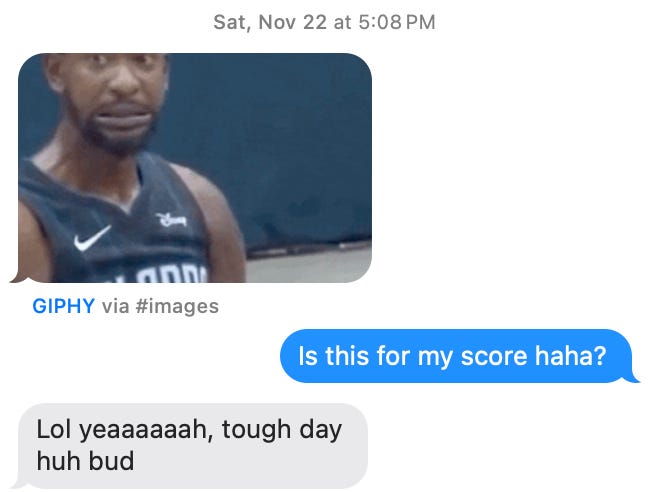
You cannot imagine how small my ego felt (I am that 100). But it’s important to note that assigning values isn’t unique to golf.
Think of gymnastics, bowling, darts, weight-lifting, or distance running. They are all value-based sports. You go home with a rolled 300, new max-bench, or sub-four marathon to identify with.
The difference between those sports and amateur golf, however, is how the value is assigned. In every domain except for amateur golf, the system assigns the value without our involvement. We cannot cheat a dart board or stopwatch or automated scoretracker like we can a piece of paper in the middle of the woods. In short, amateur golf leaves room for us to lie.
One of the best golfers I know refers to players who routinely cheat their scorecards as “Vanity Handicappers”. Sir Francis Bacon would support my friend’s coinage. In his essay, Of Truth, Bacon writes that most lies are not out of necessity, or even for personal gain, but out of pleasure. To make the world appear more beautiful than it really is.
He says that lies are like candlelight, soft and flattering, but weak and unstable. You know this from dating, from sharing a drink in a dark room under the spell of weak visibility. The small flame conceals blemishes. Accentuates jawlines. Obscures nervous fidgeting. The same principle applies to major cities – they look much better at night when the graffiti, dumpsters, and decaying infrastructure lurk in the shadows.
So what’s the big deal? Why does it matter that amateur golfers lie about their handicaps (or that IG models edit their photos)? Shouldn’t Vanity Handicappers get to feel beautiful?
It matters because, as Bacon points out, if lies are like candlelight, then truth is like sunlight on a cloudless day: harsh and revealing.
Eventually, the Vanity Handicapper will be invited to play a game for money, one where his opponents expect him to follow golf’s simple rules. He will have to punch out from under a pine. Thick blades of grass will come between his club and the ball. Worst of all, he must stand over a five foot putt for par unable to avoid the pounding of potential shame in his chest.
Like a college party house on Sunday morning, his game will be brought into the daylight and he will have never appeared so hideous in all his life.